PUSTELNY GROUP
Quantum Sensing, Fundamental Physics, Spin Systems
Menu
GLOBAL NETWORK OF OPTICAL MAGNETOMETERS
FOR EXOTIC PHYSICS SEARCHES (GNOME)
The Global Network of Optical Magnetometers for Exotic physics searches (GNOME) is a worldwide array of GPS-synchronized, magnetically shielded atomic magnetometers and comagnetometers searching for ultralight bosonic dark matter (axions and axion-like particles) and anomalous spin-dependent interactions.
ULTRALIGHT DARK MATTER & PSEUDOSCALAR SPIN COUPLINGS
Well-motivated extensions of the Standard Model predict ultralight bosons—such as axions and axion-like particles (ALPs)—with masses many orders of magnitude below neutrino masses. Because of their high phase-space occupation number in the galactic halo, these particles behave as classical oscillating or spatially structured fields rather than isolated quanta. Beyond electromagnetic couplings, ultralight bosonic fields can interact directly with fermion spins via pseudoscalar derivative couplings, acting on atomic and nuclear spins like an effective non-magnetic “pseudo-magnetic” field.
TRANSIENT EVENTS & NETWORK CORRELATIONS
While single-detector haloscopes search for persistent narrowband oscillations, spatially structured or transient exotic-field events—such as topological defects, gravitationally bound boson stars, or bursts of ultrarelativistic particles—can be mimicked or masked by local non-Gaussian noise in a single sensor. Discriminating genuine galactic or astrophysical signals from instrumental artifacts requires correlating geographically separated detectors.
GLOBAL SENSOR ARCHITECTURE
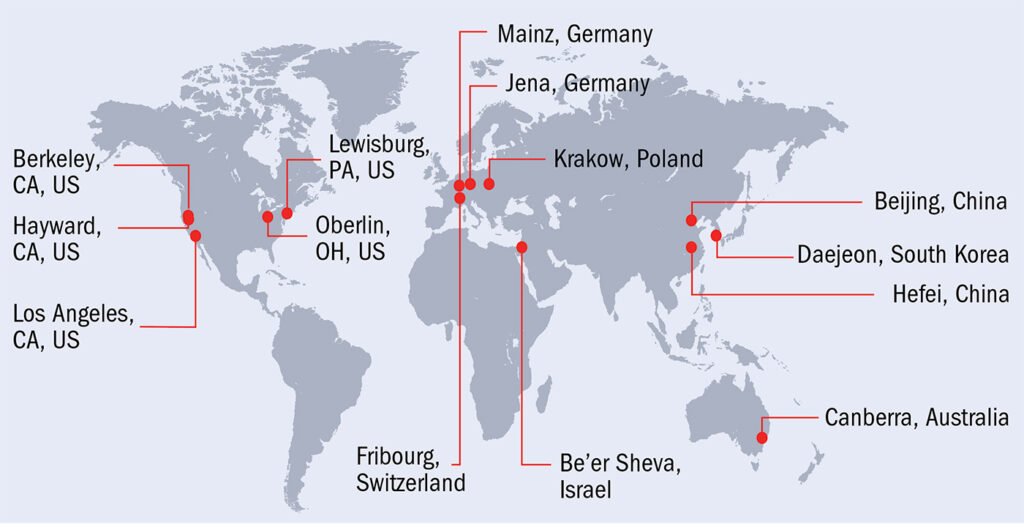
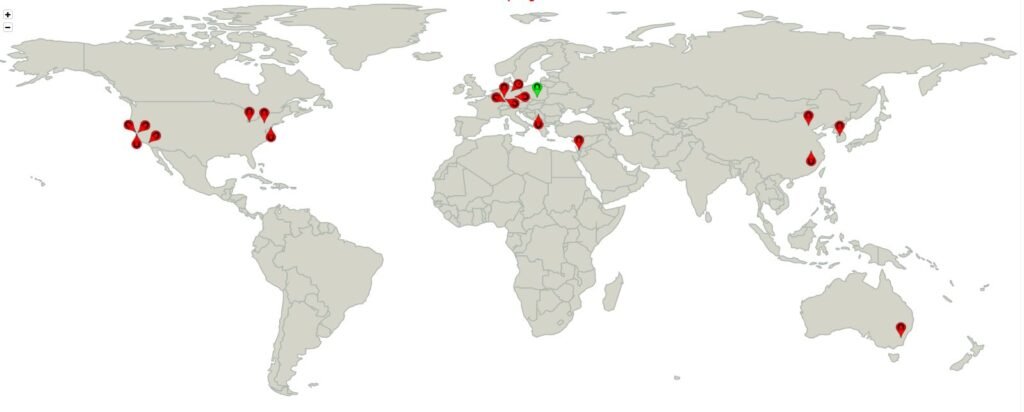
GNOME operates more than a dozen magnetically shielded spin sensors across Europe, North America, Asia, and Australia, synchronized to universal time via GPS-disciplined clocks. Each station sits inside a multi-layer mu-metal shield that suppresses environmental magnetic disturbances by factors of 106–107 while remaining transparent to exotic spin-coupled fields. As Earth moves through the galactic halo, an exotic structure traversing the planet imprints a deterministic arrival-time and vector-projection pattern across the network, enabling both background rejection and directional reconstruction.

SCIENCE RUNS & OBSERVATIONAL SENSITIVITY
Since its inception, the GNOME collaboration has completed five dedicated Science Runs alongside continuous background monitoring, recording synchronized multi-station time series with effective pseudo-magnetic sensitivities at the femtotesla level. Diagnostic characterization methods developed within the collaboration establish quantitative sensitivity across electron, proton, and neutron spin couplings.
AXION DOMAIN WALLS
In models where spontaneous symmetry breaking occurs after cosmic inflation, the ALP field can settle into distinct vacua separated by topological domain walls. Because the linear pseudoscalar interaction Hamiltonian is proportional to the spatial gradient of the field (Hint ∝ ∇a · S), spins inside a region of uniform ALP field experience no torque. Only when Earth crosses a domain wall where ∇a ≠ 0 do shielded sensors register a correlated transient pseudo-magnetic pulse.


CONSTRAINTS ON TOPOLOGICAL DEFECTS
Analysis of continuous GNOME Science Run data yielded laboratory exclusions on ALP domain walls spanning particle masses ma from 10−15 to 10−9 eV as a function of the pseudoscalar interaction scale fint and wall tension (Nature Physics 2021), probing parameter regions complementary to astrophysical bounds.
BOSON STARS, INTENSITY INTERFEROMETRY & MULTIMESSENGER SEARCHES
Beyond domain walls, GNOME searches for gravitationally bound clumps of ultralight bosons (boson stars / axion stars), stochastic virialized ALP fields via multi-station intensity interferometry (Physical Review D 2023), and transient bursts of exotic fields emitted during binary black-hole or neutron-star mergers correlated with gravitational-wave detections (Physical Review X 2025; Nature Astronomy 2021). Related intercity quantum-sensor architectures have also set stringent constraints on axion dark matter (Nature 2026).
ADVANCED GNOME: SELF-COMPENSATING COMAGNETOMETERS
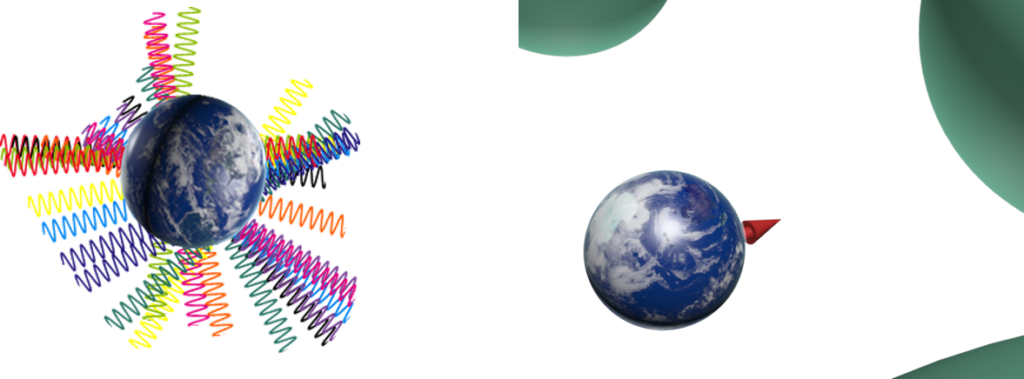
Conventional alkali-vapor magnetometers remain limited at low frequencies by residual magnetic-field drifts inside shields and primarily probe electron-spin couplings. For Advanced GNOME, our group in Kraków—in collaboration with JGU Mainz and Cal State East Bay—develops and calibrates self-compensating alkali–noble-gas comagnetometers (such as K–3He and Rb–3He/21Ne). In the self-compensating regime, polarized noble-gas nuclei cancel slow magnetic fluctuations while providing orders-of-magnitude higher sensitivity to anomalous neutron and proton spin couplings via the unpaired neutron of 3He or 21Ne (Physical Review Research 2024; Nature Communications 2025).