Pustelny Group — Quantum Sensing, Fundamental Physics, Spin Systems
PUSTELNY GROUP
Quantum Sensing, Fundamental Physics, Spin Systems
RESEARCH DIRECTIONS
Our research at the Marian Smoluchowski Institute of Physics, Jagiellonian University in Kraków centers on nonlinear and quantum magneto-optics, atomic and solid-state magnetometry, and coherent control of spin systems. Probing alkali-metal vapors, nuclear spins in liquids, and nitrogen-vacancy (NV) centers in diamond with laser and radio-frequency fields, our experiments span macroscopic femtotesla magnetometry in centimeter-scale vapor cells and nanometer-scale sensing of few-spin ensembles, with applications in fundamental physics, analytical chemistry, biophysics, and quantum information.
1. OPTICAL ATOMIC MAGNETOMETRY & BIOMAGNETISM
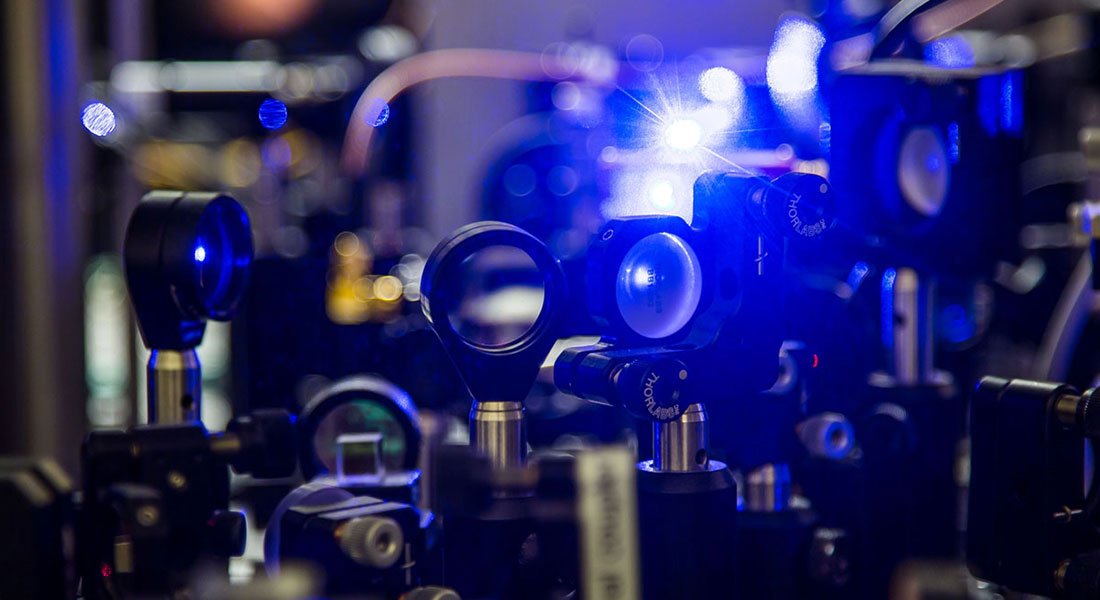
Optically pumped atomic magnetometers reach femtotesla and sub-femtotesla noise floors at room or slightly elevated temperatures without cryogenic cooling. Our group develops and characterizes several magnetometric modalities—including amplitude- and frequency-modulated Nonlinear Magneto-Optical Rotation (NMOR), rotating-polarization magnetometry, radio-frequency atomic magnetometers, and self-compensating alkali–noble-gas comagnetometers—operating from shielded zero-field setups to unshielded geophysical fields. We apply these instruments to fundamental spin-coupling tests and non-invasive biomagnetic measurements (cardiac and neural magnetic fields).
2. ULTRALIGHT DARK MATTER & EXOTIC PHYSICS (GNOME)
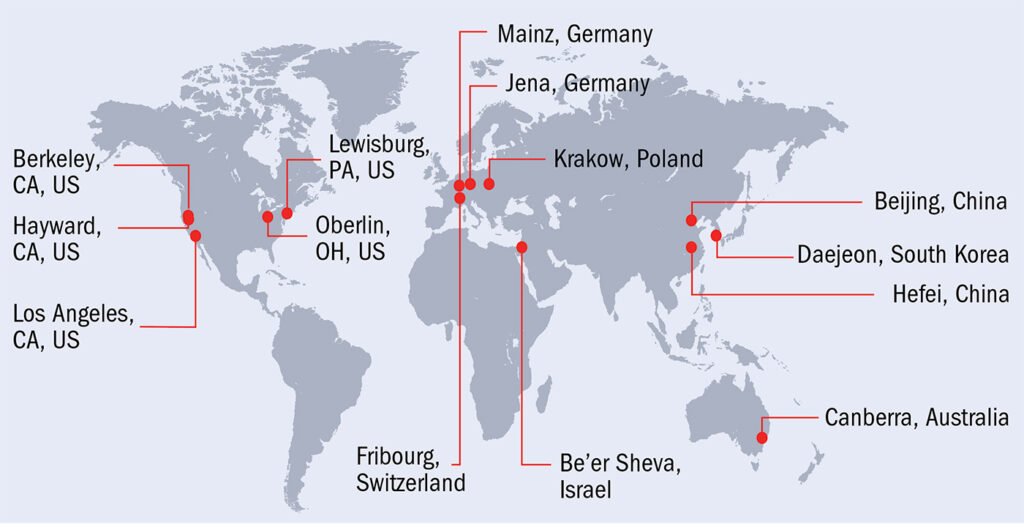
Ultralight bosons such as axions, axion-like particles (ALPs), and dark photons are well-motivated dark-matter candidates that behave as classical oscillating fields or spatially structured objects (domain walls, boson stars, and relativistic bursts). To search for anomalous spin-dependent interactions free from local instrumental false positives, we co-initiated the Global Network of Optical Magnetometers for Exotic physics searches (GNOME), correlating GPS-synchronized shielded magnetometers and comagnetometers across Europe, North America, Asia, and Australia.
3. ZERO- AND ULTRALOW-FIELD (ZULF) NMR & HYPERPOLARIZATION
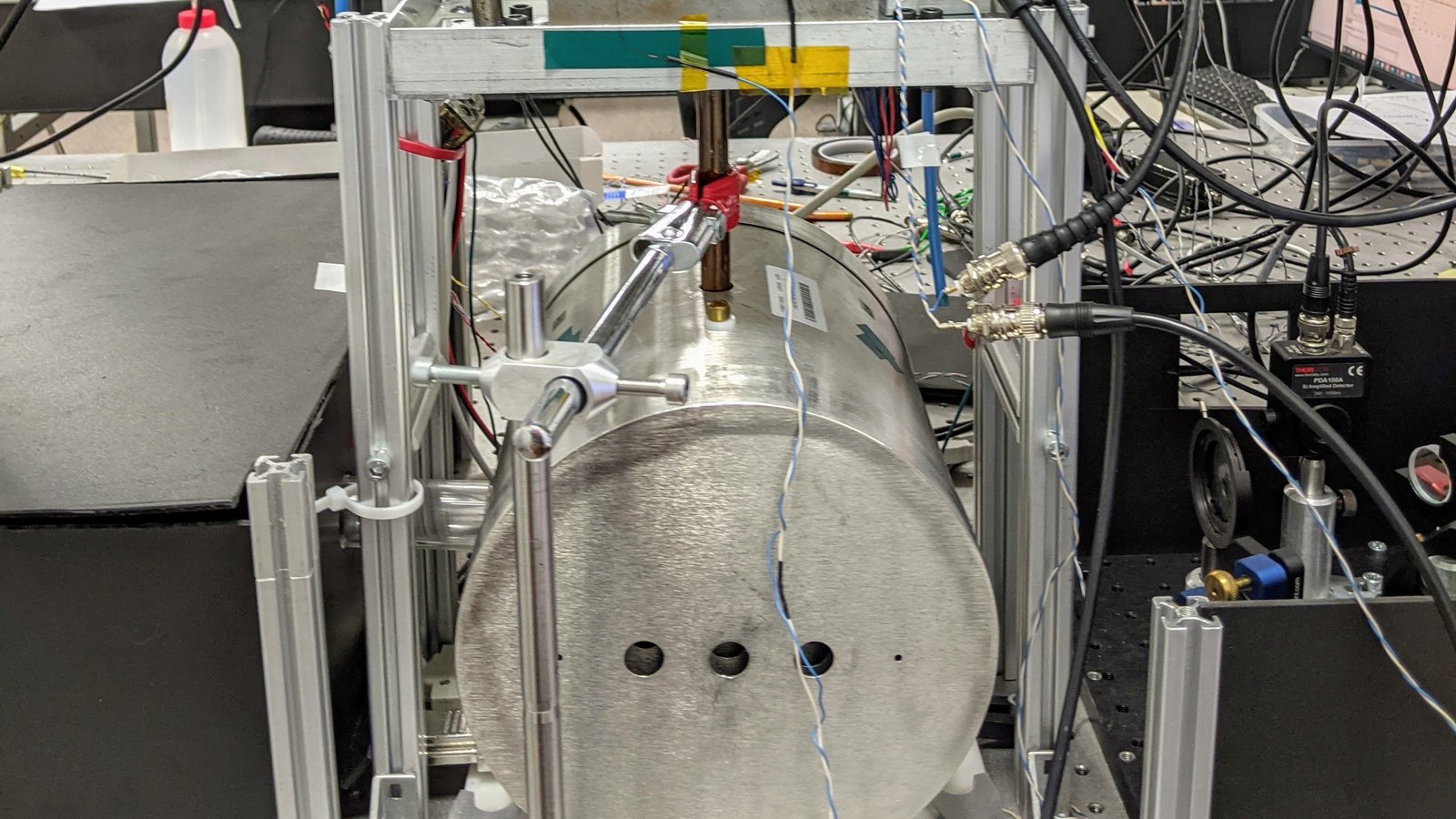
We perform nuclear magnetic resonance without superconducting magnets, detecting nuclear spin evolution in the zero- and ultralow-field (ZULF) regime where intramolecular J-couplings dominate over Zeeman interactions. Pairing optically pumped rubidium magnetometers with parahydrogen-driven SABRE hyperpolarization enables natural-abundance spectroscopy at micromolar concentrations, identification of organophosphorus compounds through conductive enclosures, and non-invasive relaxometry of whole blood.
4. QUANTUM-STATE ENGINEERING & TOMOGRAPHY IN ATOMIC VAPORS
The hyperfine ground levels of room-temperature rubidium vapor in paraffin-coated cells (spin-coherence lifetimes >100 ms) provide an accessible multilevel Hilbert space for studying collective qudits. Our group develops protocols for exciting higher-order atomic polarization multipoles, isolating pure quadratic Zeeman splittings, transferring states between hyperfine manifolds, performing non-destructive polarimetric quantum-state tomography, and testing quantum protractors and single-qudit contextuality.


5. NANOSCALE MRI WITH DIAMOND SPIN DEFECTS
Supported by a European Innovation Council EIC Pathfinder Open grant and coordinated at Jagiellonian University in partnership with Ulm University, MPQ Garching, and EPFL, we are developing a cryogen-free, room-temperature Nanoscale MRI instrument based on shallow nitrogen-vacancy (NV) defects in diamond. Combining 2D delta-doped NV layers (<10 nm depth), pulsed on-chip 3D microcoil gradients (>1 mT/µm) for k-space Fourier magnetic imaging, spin-1 Hamiltonian engineering, SPAD-array readout, and 2D van der Waals nanofluidics, the project aims at 10-nm spatial resolution for single-molecule structural studies of disordered proteins.
EXPERIMENTAL INFRASTRUCTURE
Our laboratory combines advanced laser spectroscopy, magnetically shielded precision measurements, and custom-built magnetic resonance systems. Much of our instrumentation is developed in-house, integrating sophisticated optical setups with precision electronic control, microwave and radio-frequency systems, and low-noise signal detection.
Laser Spectroscopy & Coherent Spin Control
- Tunable diode lasers and precision optical systems for atomic spectroscopy, optical pumping, and coherent control of alkali-metal spins.
- Custom experimental platforms for quantum-state preparation, manipulation, and optical readout.
Precision Magnetometry & Magnetic Shielding
- Magnetically shielded laboratory equipped with field-control coils, ultrasensitive atomic magnetometers, and low-noise detection electronics.
- Specialized atomic magnetometer and comagnetometer setups supporting precision magnetic measurements and GNOME searches for exotic spin interactions.
Zero-Field & Benchtop NMR
- Custom-built ZULF NMR instrumentation combining optical atomic magnetometry with remote thermal prepolarization and parahydrogen-based techniques, including PHIP and SABRE.
- Oxford Instruments benchtop NMR spectrometer for complementary spectroscopy and sample characterization.
RESEARCH FUNDING & SPONSORSHIP
Our research at the Marian Smoluchowski Institute of Physics is supported by competitive national and international grants, including the European Innovation Council (EIC Pathfinder Open), the National Science Centre (NCN — OPUS, SONATA BIS), the National Centre for Research and Development (NCBR), the Foundation for Polish Science (FNP), the Kosciuszko Foundation, and the Polish-U.S. Fulbright Commission.
INSTRUMENTATION & DM TECHNOLOGIES
Precision atomic and spin experiments depend on custom low-noise electronics and timing hardware developed alongside laboratory research. DM Technologies, a scientific-instrumentation company led by Prof. Szymon Pustelny, designs and manufactures specialized measurement hardware for quantum physics and dark-matter experiments—including GPS-disciplined data acquisition systems with sub-microsecond timing precision, nanoampere-stability multichannel current sources, programmable narrowband digital filters, and low-noise multichannel relays.